Philanthropy, Get In The Pool

Black Philanthropy Month arrived this year with a contradiction the sector should not celebrate its way around. We are honoring Black generosity while many organizations closest to Black communities still struggle to gain entry into larger institutional philanthropy. While written about before, this fact should be revisited with a new lens.
According to a 2026 study by Candid and ABFE, in a typical year between 2016 and 2023, only half of the Black-led nonprofits studied received even one foundation grant, compared with 70 percent of white-led nonprofits. Among small, Black-led organizations, only three in ten received a grant. The surge in giving after the 2020 racial justice uprisings reached a relatively small number of large organizations and was already receding by 2023.
Recently, Eric and Marcus, joined by Race Forward’s Julie Nelson, spoke with members of the United Philanthropy Forum about racial justice, philanthropy, and democratic governance. We reached the same conclusion: philanthropy still believes it can watch the authoritarian storm from a safe distance while it is already standing inside it.
The attacks on racial justice, honest education, civil rights protections, community organizations, and local government are part of the same effort to narrow who may participate in public life, which histories may be told, and which institutions may challenge concentrated power. Philanthropy does not operate as a neutral force in society and pretending that it does obscures the more important reason it is under pressure: it can move significant resources independently of government to support the values of civic participation, community power, culture, and accountable governance.
We are praising Black resilience while continuing to underfund the institutions and leaders that make resilience possible.
We are praising Black resilience while continuing to underfund the institutions and leaders that make resilience possible.
That capacity helps make multiracial governance possible. By that, we mean people of different races, faiths, abilities, backgrounds, and places sharing public power and making decisions together about schools, budgets, housing, health, and the future of their communities. Authoritarian politics depends on persuading people that their neighbor’s participation is a threat and that another community’s dignity represents their own loss. The wedges reach our own institutions, too. We reinforce them when we separate democracy funding from racial justice, policy from culture, or dismiss networks and intermediaries as overhead when they are often what keeps organizations from being isolated and defeated one by one.
The pressure is no longer hypothetical. According to the Chronicle of Philanthropy, a Trump administration proposal would give federal agencies greater power to terminate grants, deny support for work the administration opposes, and allow political appointees to determine which grants serve the “national interest.” Nearly 100,000 public comments were submitted in response. The Chronicle also reported that direct federal grants to everyday charities fell nearly 38 percent between comparable eight-month periods in 2024 and 2025. Organizations are being asked to absorb enormous public funding losses while confronting rising need, political hostility, legal uncertainty, and philanthropic caution.
Some funders have stepped up, and that leadership should be recognized. Open Society Foundations has committed $300 million over five years to defend civil liberties and civil society. United Philanthropy Forum and other networks have mobilized members against threats to nonprofit independence. ABFE has turned a hostile environment into research, community, strategy, and a demand for sustained investment in Black leadership.
Funders for Justice has offered another important model. Its Safety and Security Pledge treats physical, digital, legal, emotional, and economic protection as a shared responsibility across philanthropy, not as a burden each targeted organization must carry alone. Protection cannot become another unfunded requirement placed on movements already carrying the greatest risk.
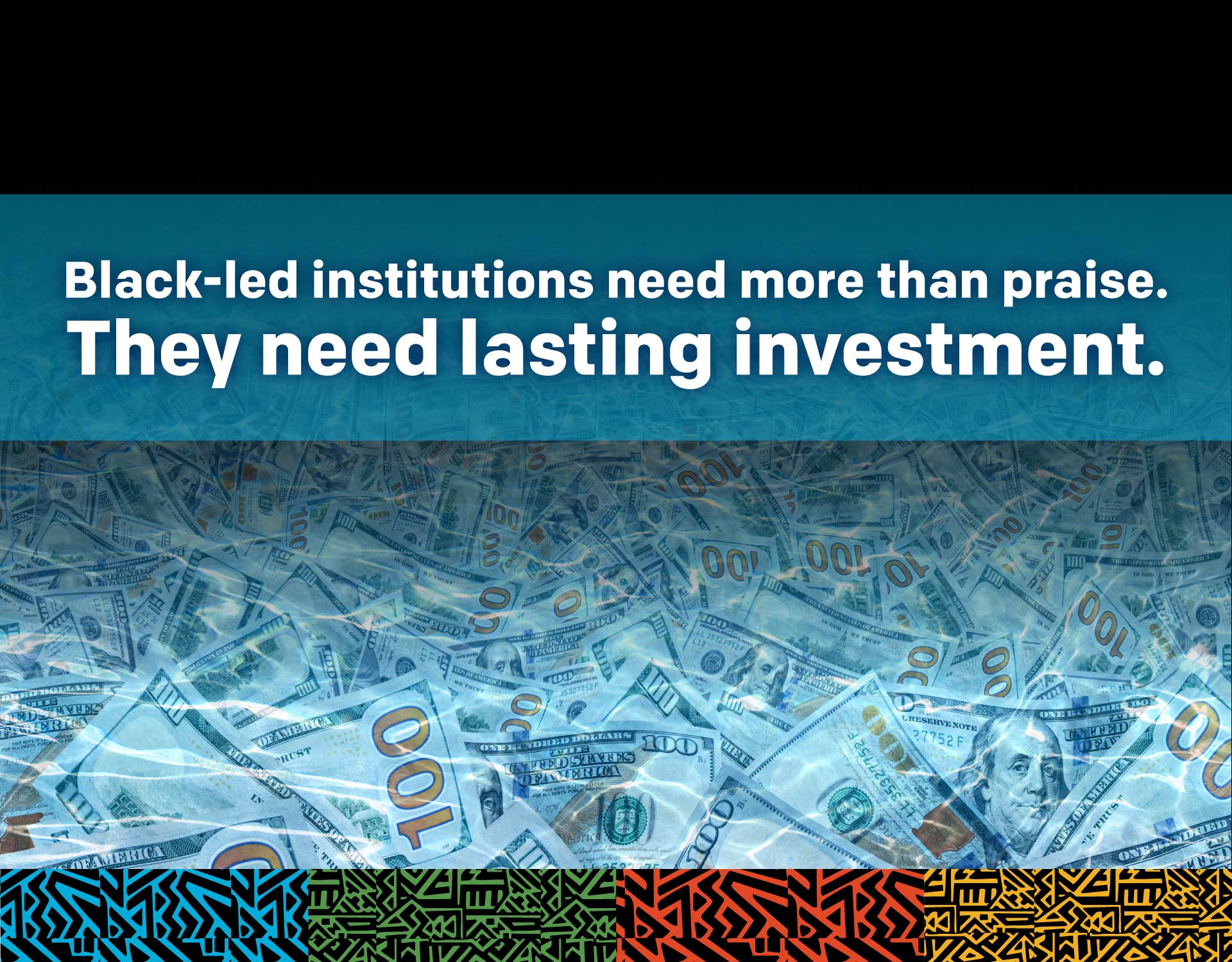
We should learn from these examples without mistaking them for the norm. Philanthropy cannot put 5 or 10 percent of its resources into the pool and proclaim that it is swimming on behalf of an inclusive multiracial democracy. A foot in the water is not swimming. A rapid-response fund cannot compensate for a growing segment of philanthropy that chooses to act as though the emergency belongs to everyone else. While the attack on racial justice is real, the current backlash is not proof that racial justice failed. It is evidence that racial justice moved the line by changing institutions, expanding public participation, strengthening community power, and increasing expectations of accountability. The question is whether philanthropy will help hold that line.
That requires what we call protective generosity: real long-term general support, not grants that force organizations to plan one season at a time. Legal defense, compliance, physical and digital security, communications, and leadership care must be funded as part of the work. So do the relationships between organizations that allow people to exchange information, coordinate strategy, share risk, and stand together when one is targeted.
People learn who belongs from what their children read at school, what they hear in church, what moves through TikTok, the music they play, the stories local news chooses to tell, and the jokes people repeat when they think nobody important is listening. Philanthropy cannot continue financing policy as the “serious work” while treating culture as an optional extra. Winning a court case while losing the public imagination is not victory. The scale of philanthropy’s response should bear some relationship to the scale of the danger it says it recognizes. And to be plain, a two-year grant is not a long-term commitment.
But philanthropy is not the only audience for this call. Movement leaders must expand our understanding of what resistance requires. Opposition and critique remain necessary, but they are not enough. We cannot spend this era only identifying institutional failures, protesting government abuse, and demanding that others do better. We must also identify the institutions an inclusive democracy cannot afford to lose and organize to defend them.
That includes philanthropy when it is attacked for supporting racial justice and civic participation. It also includes libraries, schools, election offices, independent media, nonprofit organizations, and local governments. Defending an institution does not mean pretending it has always served our communities well. It does not require suspending criticism or abandoning demands for transformation. An institution can require change and protection at the same time. Authoritarian movements often isolate an institution, discredit it, weaken its allies, and then dismantle it while potential defenders remain on the sidelines. Movements must interrupt that sequence. We must become builders and defenders as well as critics.
Local government must also step up. Too many officials behave as though communities and nonprofits are under attack while government itself is merely being inconvenienced. That is a dangerous misreading of the moment. Governance grounded in racial justice, belonging, and democratic practice is under attack.
Local governments still control budgets, public employment, procurement, libraries, schools, public health, local data, land-use decisions, and civic space. They possess legal standing, convening authority, and the ability to bring philanthropy, movements, labor, business, and residents to the same table. They can protect employees facing intimidation, preserve racial data, defend honest history, direct contracts toward trusted community organizations, challenge unlawful federal conditions, and open public institutions to greater civic participation.
Local government is not the minor leagues. It is where people experience whether democracy works, whom it works for, and whether they belong within it.
Black philanthropy offers all three sectors a direction. Black giving did not begin with foundations, professional grantmaking, or the tax code. It grew from people pooling money, food, shelter, knowledge, relationships, and risk to build institutions a racially unequal society refused to provide. It has always been survival, resistance, repair, imagination, and governance.
Black Philanthropy Month is built around a long tradition of collective giving and shared responsibility. This year, one of its national campaigns captures that tradition in four words: ‘Many Voices. One Movement.’ This cannot mean ‘Many’ philanthropic statements while every institution and donor protects its own endowment, brand, jurisdiction, or campaign. It must mean that when one part of democratic society is targeted, the others move toward it rather than away.
Philanthropy must put more than its foot in the water. Movements must defend as well as oppose. Local government must govern like it still has power, because it does. Multiracial governance will survive only if philanthropy resources it, movements organize to protect it, and public institutions practice it. That is the work before us.
History will judge us by how we showed up, and how we did not.
Deborah Aubert Thomas is President and CEO of United Philanthropy Forum, a national network strengthening philanthropy’s infrastructure, leadership, and collective impact.
Marcus F. Walton is President and CEO of Grantmakers for Effective Organizations (GEO), where he advances equitable, effective, and community-centered philanthropic practice.
Eric K. Ward is Executive Vice President of Race Forward, a civil rights strategist, writer, and nationally recognized expert on democracy and organized bigotry.