May Day Matters Now More Than Ever

It seems as though everyday we wake up to new crises manufactured by the greed of the billionaire/Epstein class,desperately trying to maintain their grip on their rigged economic system. But it's critical we don’t forget how 2026 has also been a year of historic multiracial solidarity uprisings in Minnesota. “This Is How We Win” is a new book co-edited by Sarah Lazare, Amie Stager and May Day Strong and fast-tracked by Haymarket Books to share lessons we need now more than ever – from the Minnesota shutdown to the ways general strikes and collective action can serve as critical tools for working people to win positive change.
Race Forward is a proud member of the May Day Strong network, and we were thrilled to see this book highlight lessons from the historic Minnesota solidarity shutdown on January 23, 2026, in response to the ICE attacks this winter. It is astonishing how quickly they were able to work with a broad range of contributors–including rank-and-file workers, labor leaders, community organizers, journalists and historians–to get these lessons into the hands of the public. Together they provide much-needed fuel for anyone committed to raising our collective expectations and building the power we need to overcome the billionaire elites who are doing everything they can to keep us divided and down, while hoarding unimaginable power and wealth.
Rightfully, a lot of our attention for our movements are in November and what’s at stake in the 2028 election. However, this concise and potent book is packed with insightful strategies and inspiration that our movements also need to harness as we build momentum for May Day 2027 and 2028. It’s worth setting the context for the enormous significance of May Day before turning to the invaluable Minnesota examples that offer lessons for how we can build momentum, and, ultimately, win, as highlighted in This Is How We Win. Here is an excerpt from The Book of Embraces by Eduardo Galeano that I’ll never forget reading as a young organizer.
Forgetting
Chicago is full of factories. There are even factories right in the center of the city, around the world’s tallest building. Chicago is full of factories. Chicago is full of workers. Arriving in the Haymarket district, I ask my friends to show me the place where the workers whom the whole world salutes every May 1st were hanged in 1886.‘It must be around here,’ they tell me. But nobody knows where. cNo statue has been erected in memory of the martyrs of Chicago in the city of Chicago. Not a statue, not a monolith, not a bronze plaque. Nothing.
May 1st is the only truly universal day of all humanity, the only day when all histories and all geographies, all languages and all religions and cultures of the world coincide. But in the United States, May 1st is a day like any other. On that day, people work normally and no one, or almost no one, remembers that the rights of the working class did not spring whole from the ear of a goat, or from the hand of God or the boss.
Thankfully, since Galeano wrote this decades ago, there has been a growing consciousness of May Day’s history, and, more importantly, a growing determination to draw from that history as we make history ourselves. As you will read in This Is How We Win, that is precisely what Minnesotan educators, rank-in-file union members, students, immigrant rights organizers, faith community leaders and neighbors from every walk of life proved when they responded to violence of the ICE attacks in Minneapolis and Saint Paul this past winter.
The Minnesota example is a threat to the billionaire class
I have long been an admirer of the labor movement in Minnesota, and this book offers a glimpse into the brilliant and hardworking organizers that have been building strategic, cross-sector solidarity for years. One of them is Greg Nammacher, the president of SEIU Local 26, who has been at the center of this work and whose union was among those that came out early in response to ICE’s Operation Metro Surge. Nammacher breaks down the organic and organized response that took shape across the Twin Cities. One quote that best captures the spirit of what made this mobilization so powerful. Christin Crabtree, a Minneapolis Public Schools parent, told Workday Magazine: “Something I love most about this city is that we know how to organize,” She added, “There are more of us than there are of them.”
Also included is the voice of Marcia Howard, president of the Minneapolis Federation of Educators, Local 59, another courageous union leader whose members supported the January 23 shutdown and who has since been targeted by the Trump administration for standing up to ICE. Howard makes clear what is at stake, pointing out that “we’re at war with the billionaire class” and Minnesota being targeted in an attempt to break the solidarity that is growing there. As she puts it, “if they could break Minnesota, they could use this as a beta test for how they could break the United States.” She also emphasizes that the January 23 shutdown was not simply the result of unions mobilizing in a moment of crisis, but the years of strong cross-movement organizing with faith communities, worker centers, and cultural organizations. That infrastructure of solidarity, built over more than a decade, helped make the scale of January 23 action possible, where more than a quarter of Minnesotan households participated in the day of protest.
May Day Strong is building the power to take on the authoritarian far right
Saqib Bhatti, of the Action Center on Race and the Economy (ACRE), lays out why This Is How We Win highlights the example of Minnesota’s large-scale economic disruption of workers and communities is critical for our fight ahead. He writes, “There is a global history of regular people rallying together to defeat cruel and murderous leaders, through organizing, noncooperation, and striking. This won’t look the same everywhere; we aren’t suggesting that we copy-paste the Minnesota model. Rather, we all need to take stock of our own context, conditions, and alliances, while also looking to draw on the hard-won victories of others.”
This book was co-published by May Day Strong, a fast growing network of unions and community organizations that, as Bhatti states, “is trying to build a movement to stop fascism by taking on the billionaire oligarchs and building our capacity for real economic disruption.” May Day Strong was born in the Fall of 2023, following UAW President Shawn Fain’s call for unions to align their contracts around May 1, 2028, creating the possibility of a nationwide general strike. In many ways, this echoes May Day 1886 general strike for the eight-hour-day, a movement that began taking shape in 1884, when the Federation of Organized Trades and Labor Unions called for May 1, 1886, as the date for a nationwide strike if the eight-hour day was not won. The Knights of Labor were among the major labor organizations that helped build the movement, which ultimately brought hundreds of thousands of workers into action. Since 2025, hundreds of organizations, including Race Forward Action and Public School Strong, have been coordinating actions around May Day and Labor Day to build momentum to a large-scale national general strike in 2028.
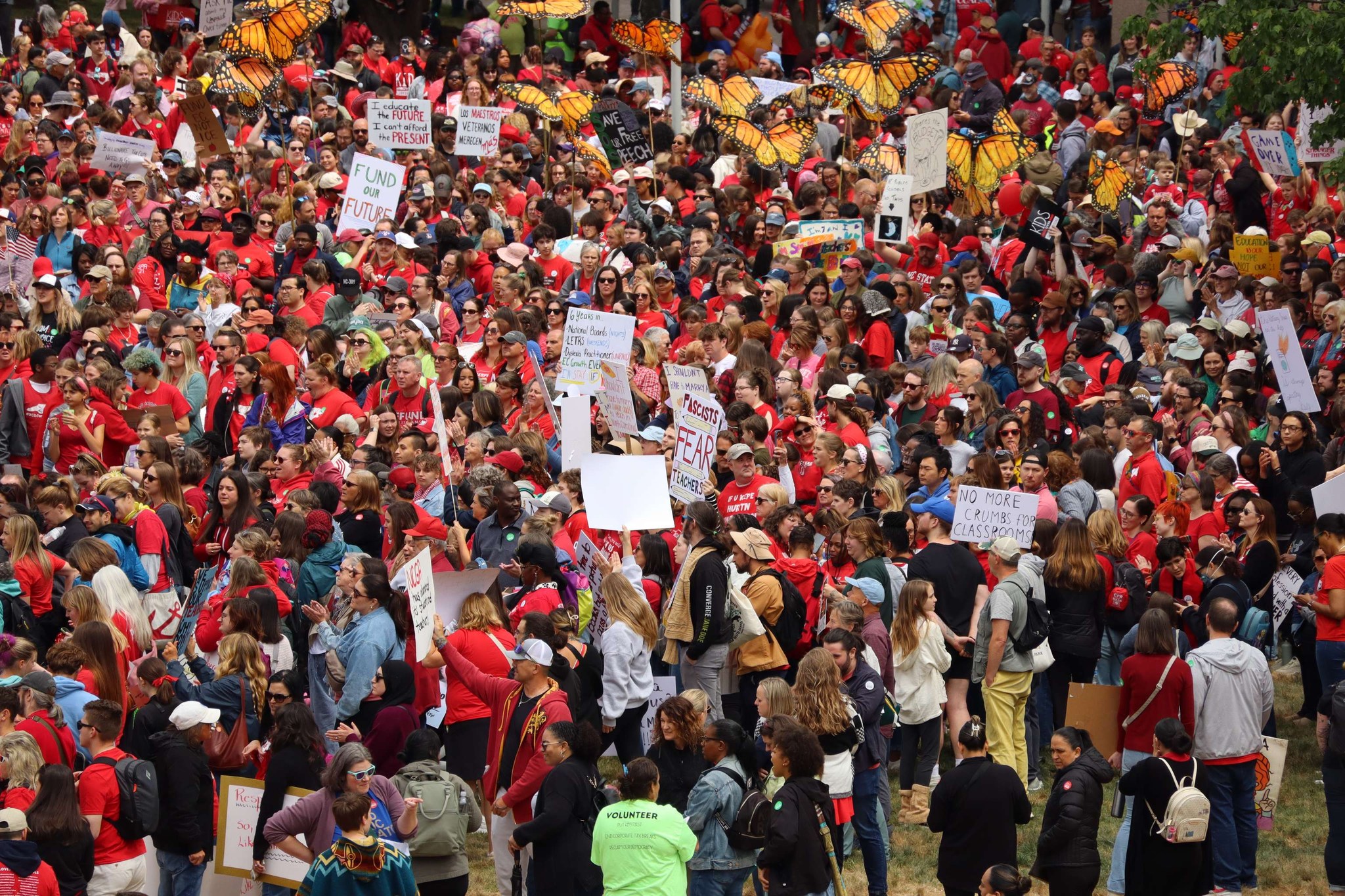
One of the best examples is from May 1, 2026 when 15,000+ North Carolina public school educators and working people held a massive Kids Over Corporations march and rally in their capital in Raleigh. It was one of the largest political rallies in North Carolina history and the largest of the over five thousand national May Day Strong Workers Over Billionaires rallies held across the country. The second half of This Is How We Win turns to historians who trace the history of general strikes, not only as a powerful tool for expanding workers’ rights and improving working conditions, but as means of challenging authoritarian rule and defending democracy.
There is a lot of powerful history and wisdom from our ancestors jammed into this short book that we highly recommend picking up and passing on to your co-workers. If your organization is not yet part of the May Day Strong, you should get them to join. We would be thrilled to keep organizing and building momentum towards May Day 2027 and 2028. Given our political crisis, climate chaos, and the dangers of AI being pushed by Big Tech, we will need both worker power and political power to advance a much needed social contract in our country. I highly recommend also checking out Real Affordability Agenda here https://maydaystrong.org/affordability to see a detailed outline of what May Day Strong is fighting for.
James Haslam is the VP of Movement Building at Race Forward