May Day: A Fight for People, Power and A New Narrative


What does collective action look like in practice?
It looks like September 2019, when the largest youth-led climate strike brought an estimated 4 million people to the streets across continents to stand up for the climate emergency. Collective action also looks like students across 500 U.S. universities who led anti-Gaza war/pro-Palestine protests that started April 2024. Students collectively participated in more than 3700 days of protest activities. Aligned faculty are still facing consequences for speaking out today.
Underlying many of these struggles is a broader narrative fight. The elite billionaire class, aligned political actors, and robustly-funded organizations have had far too much political influence. Together, they are working to shape a public narrative that downplays climate and health risks, promotes false solutions, and introduces sharp divides in our culture. Right now, countering this public narrative is a key task for the labor movement and parallel movements in education, climate and beyond as the working class is being squeezed.
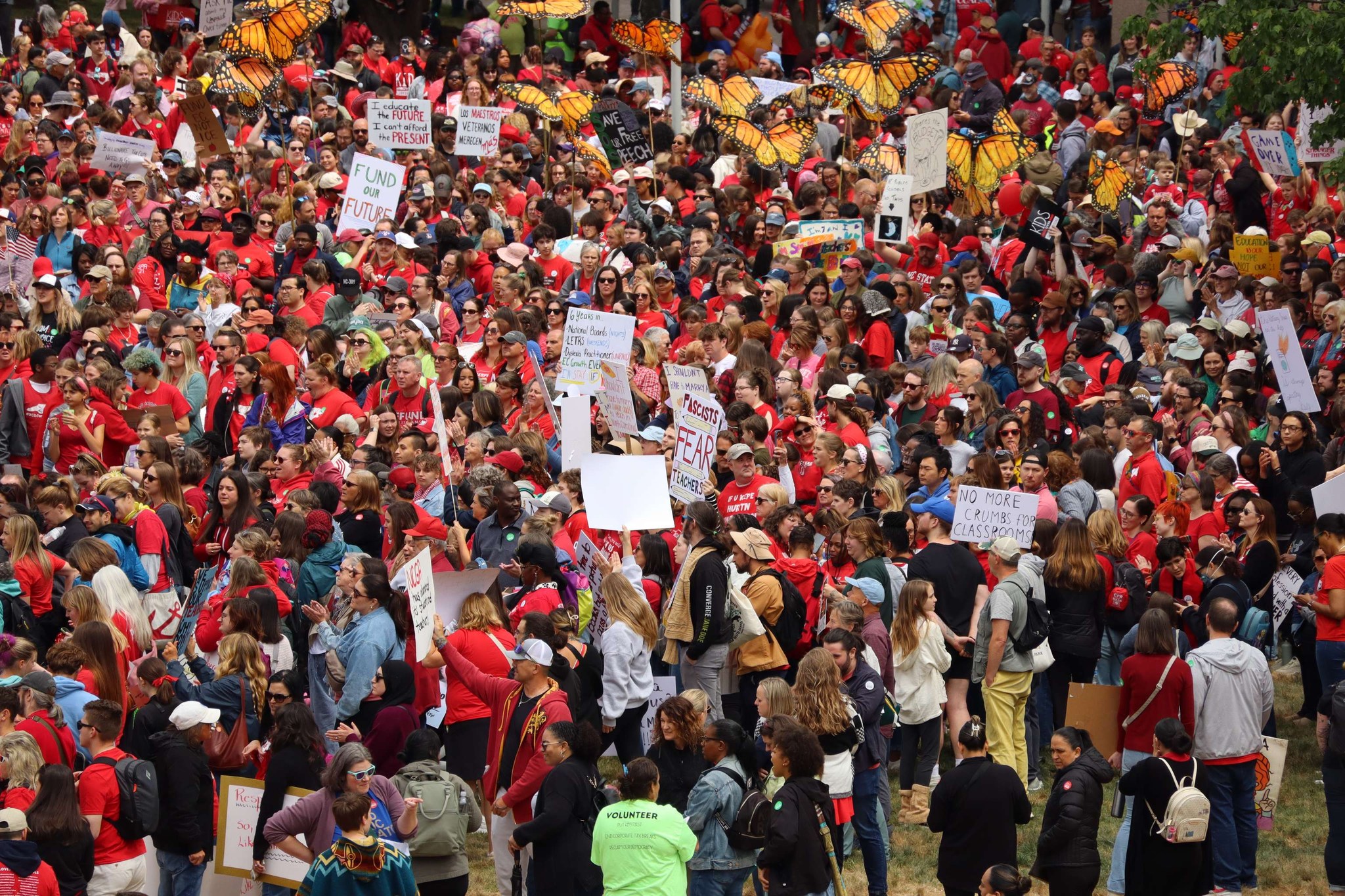
On May 1—International Worker’s Day, organizers, educators, social justice organizations, and everyday people and workers will fight this harmful public narrative and demand that we put workers over billionaires. This nationwide day of collective action pushes both for the protection of our democracy as authoritarianism has quickly permeated our society. It is clear that the narratives controlled by the billionaire class and aligned political actors serve to protect entrenched systems of power and profit at the expense of communities and everyday workers.
“When we have the power of labor fused with the power of social movements, that’s when we can truly challenge the power of the billionaires,” said Hagopian.
Climate As a Labor Right
For Leah Obias, Director of Policy and Strategy at Race Forward, the core messaging of May Day is to look at labor through its intersections. Wealth inequality coupled with the racial wealth gap, compounded with the combination of rising temperatures, rising sea levels, wildfires and flooding all bundle into an existential crisis, they explain. “When you look at the state of the working class, we’re already facing extreme forms of economic hardship, general affordability issues and the rising costs of living," said Obias. There has not been an increase in the federal wage requirement since 2009, stagnating at $7.25 per hour. In some localities such as DC and Connecticut, the minimum wage is just over $16 an hour but that is by no means the norm. In many states across the south and Midwest, like Louisiana and Iowa, the federal wage is the standard. While everyday Americans struggle to keep the lights on, an added stressor such as a climate disaster is just the tip of the iceberg.
A considerable slice of the US labor force is immigrant workers who can be defined as persons who moved to a different country, either permanently or temporarily to seek employment. According to the US Bureau of Labor Statistics, immigrant workers were more likely to be employed in service occupations and are less likely than native born workers to be in managerial or professional/corporate positions. Such occupations can include construction, childcare, agriculture, maintenance, production/manufacturing and transportation. These positions are often more precarious, more likely to have workplace violations, and are more likely to be exposed to climate risk. “In addition to facing really difficult situations in their workplaces, because of the lack of labor protections…they’re dealing with racism, increased violence, wage theft [and], increasing violence by ICE and immigration enforcement,” said Obias. When thinking of May Day as a day for International Workers, climate impacts particularly hit immigrant workers in acute ways.
“Climate Justice overall asks us as people who are working for and interested in racial justice to look at the underlying systemic issues and confront those if we’re going to be resilient,” said Obias. Where do the principles from labor, education, climate and health justice movements align? Obias points us to the just transition which is a vision to build economic and political power that moves us away from an extractive economy to a more regenerative one. The just transition’s core principles are to work towards renewable energy, decentralized power to maintain democracy, international solidarity and dignified jobs. “Dignity is not just for workers but there’s an interconnectedness, for communities of color, and for our communities in general and for our planet,” said Obias.
There are promising examples of the just transition, climate and labor alignment at the local level.
In New York City, a Bronx-wide coalition of community organizations is advancing a comprehensive economic development strategy (CEDS) that integrates environmental resilience as a core tenet. Led by The Bronx Economic Development Corporation and Our Bronx, the coalition is also working on a green jobs accelerator focusing on workforce development in sectors such as solar energy and green building, aiming to create pathways into a sustainable economy. Aside from the community organizations, large scale placed- based organizations are also part of this development strategy. As part of Race Forward's Policy Innovation Lab, the coalition is working towards co-governance and policies that undo some of the climate harms plaguing the city.
This does not just stop in New York City. The Indigenous Idaho Alliance is another coalition that recognizes the intersections of labor by working on issues around housing, language justice, food justice and more. Core to the alliance’s work is the Idaho Organization of Resource Councils, a farm worker organization who is focused on getting more protections for this demographic. “There are groups and corporations that are actively fighting laws that protect workers from extreme heat,” Obias shares. Idaho law does not require employers to provide rest periods or meal breaks. “In general, domestic workers and farm workers are exempt from basic labor protections—so no work, no pay,” said Obias.
Education: A Labor Justice Battleground
Traditionally, May Day has focused on worker’s economic demands. But educators are bringing a new perspective to the conversation and arguing that their rights, as workers, include being able to teach in classrooms that are free from political censorship. “Education is one of the central battlegrounds where the meaning of workers rights is really being redefined,” said Jesse Hagopian, Campaign Director at the Zinn Education Project, a platform that promotes and supports the teaching of people’s history in classrooms nationwide.
Educators, Hagopian explains, have been at the forefront of expanding the definition of workers rights to include that they have a right to teach the truth, deserve to teach in schools that are fully funded, and safe. Billionaires like Charles Koch and Betsy DeVos have invested heavily in the privatization of schools and have advocated for what Hagopian called “truth crime laws”, which are laws that make it illegal to teach about America’s Indigenous, Black and other histories. “This really is a fight over knowledge itself—what’s going to be allowed to be learned and understood?,” said Hagopian.
Recently, the Zinn Education Project surveyed educators across the country about the impact of educational censorship laws in their classroom and there has been a chilling effect. “One teacher said that there is an unspoken rule to play it safe,” said Hagopian. Educators have shared that they have seen colleagues fired for teaching about racism. Even as early as 2023, a RAND study revealed that two out of three teachers in the US are currently censoring their curriculum because they are worried about attacks. “I got a text from my child’s school a few weeks saying that the school was in lockdown because ICE agents were in the area. If you’re an immigrant family, imagine that terror,” said Hagopian.
When this kind of resistance and truth teaching in our classrooms gets diminished, the critical examination of our society’s brutal history gets watered down. “They [billionaire class] want to use these truth crime laws to drive voters to the elections…and want to use the fear of teaching honestly about race to drive families out of public schools,” said Hagopian. This creates a trickle down effect—a decrease in enrollment leads to a decrease in funding and an eventually crumbling of a public good.
The recent ICE protests in Minneapolis highlighted what the resistance could look like—with educators at the forefront. Educators there led the fight for immigrant rights while defending the children they teach. It is clear that Minnesota had the infrastructure in place to mobilize quickly. For example, a powerful alliance working to protect public education is Take Action MN. Their organizing centers around the push to fully fund public schools, tenants rights, and civic engagement. And in states like North Carolina, this resistance continues. Groups like Durham Public School Strong, Down Home NC and North Carolina Association of Educators (NCAE) continue to demonstrate how impactful collective action can be. Race Forward's HEAL (Honest Education, Action and Leadership) Together program partners with the Zinn Education Project on the Teach Truth campaign as part of the national Public School Strong initiative. On May Day, the Public School Strong initiative will mobilize nationwide.
For both Obias and Hagogian, May Day is a powerful opportunity to connect struggles that are too often treated as separate. This year and in the very city in which May Day started, the Chicago Teachers Union fought to make May Day a day of civic action in public schools, meaning that educators and students won the right to attend rallies and learn about the history of labor struggles.
“We have to be able to address and put forward our own narratives as a movement to advance our goals of solidarity and justice,” said Obias. That narrative includes amplifying the fact that it is our labor that builds the wealth of our society and that labor and when standing together, has the power to change the current destructive and extractive trajectory we are on. “When we have the power of labor fused with the power of social movements, that’s when we can truly challenge the power of the billionaires,” said Hagopian.