The Builders of Movements


Celebrating the women who have shaped what justice looks like in education, civil rights, disability visibility and climate.
History rarely announces the women who build it. Moreso, movements in hindsight so frequently emphasize charismatic martyrs or marches rather than the consistent, longstanding, and quiet work that mobilizes people to action.
This year, we celebrate 250 years of the American Experiment, a series of democratic systems and institutional scaffolding made possible by the revolutionary actions of the disenfranchised and discredited. It’s easy sometimes, amidst the waving flags and pageantry, to forget that everything good and just in this country was fought for and won by everyday people. And when reflecting on liberation movements—Civil Rights, the Chicano Movement, Indigenous sovereignty, housing justice, environmental justice, you name it—the consistent and often under recognized revolutionary tends to be the woman whose silent labor and steady hands have led the organizing and institution-building work.
This Women’s History Month, we recognize the women who have shaped and are continuing to shape what’s possible.
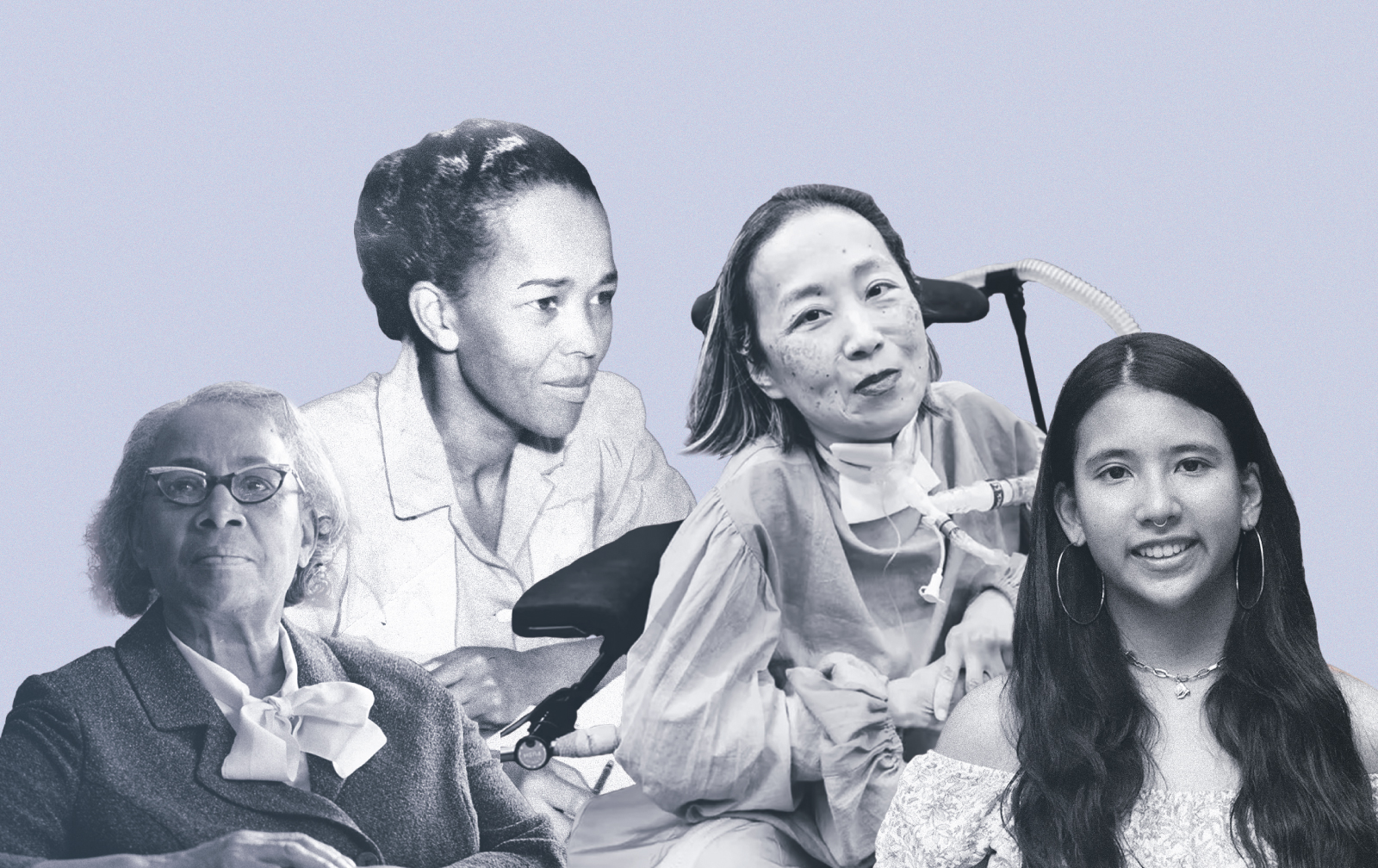
From left to right: Septima Clark, Ella Baker, Alice Wong and Alexia Leclercq.
Septima Clark
The Carolinas in the 1950s were a time touched heavily by the harsh realities of Jim Crow. During this time, activists, faith leaders, and teachers were hatching plans to ensure every U.S. citizen could act upon their constitutionally-appointed right to vote. On Johns Island, a marshland coastal community just outside of Charleston, South Carolina, this looked like members of the mutual aid organization, the Progressive Club. There, Black citizens were taught how to pass literacy tests designed to keep them from the ballot box. At the helm was Septima Poinsette Clark, a teacher born in 1898, who understood the importance of literacy for Black folks, who were historically and systematically barred from education.
In 1956, following the passage of Brown v. Board of Education, vocal Black educators like Clark in South Carolina were asked to hide their NAACP membership because of a state law that prohibited government employees from belonging to Civil Rights organizations. Rather than acquiesce to the powers that be, Clark began to utilize teaching as a form of organizing by facilitating training and workshops through the NAACP and eventually the Progressive Club. Clark would go on to partner with fellow organizers Bernice Robinson and Esau Jenkins to establish some of the earliest “citizenship schools” at the Highlander Folk School on Johns Island. The citizenship schools became a model that eventually helped adult learners across the Southeast with reading voter registration forms, practicing signatures, and building confidence in the face of both literacy tests and hostile registrars. The pedagogy was grounded in respect: Lessons used everyday language, and sample ballots became textbooks. A single trained participant could return home and teach another circle, creating a radiating effect. By the early 1960s, when the Southern Christian Leadership Conference (SCLC) absorbed the program, thousands across the South had passed literacy tests and registered to vote, all with Clark’s accessible and community-centered teaching model.
Throughout her life, Clark insisted that education was a foundational piece of the democratic process. She pressed for sustained investment in political education, acknowledging the power of an informed electorate. This mentality continued to grow and, just a few years later, in Spring 1960, students from North Carolina Agricultural and Technical Institute and Bennett College took up lunch counter seats at a segregated Woolworth's, beginning a national sit-in movement that helped to transform the fight for voting rights and student advocacy.
Ella Baker
These sit-ins, birthed in North Carolina, served as the launching point for the Student Nonviolent Coordinating Committee (SNCC), an organizing body comprised of young people attempting to face segregation and voter suppression head-on. One of their foundational organizers and mentors was Ella Baker.
Born in 1903, Baker spent much of her younger years organizing with the NAACP, supporting recruitment and Southern engagement as a field secretary before being promoted to National Director of Branches and later president of New York’s NAACP branch. Her focus was on bridging the class and accessibility divides between her peers and impacted communities. Although much of the NAACP’s work at the time focused on court cases and judicial engagement rather than on-the-ground movement building, Baker was able to support the creation of the SCLC as one of its grassroots organizers. Eventually, inspired by the student sit-ins and the Montgomery Bus Boycotts, Baker visited her alma mater, Shaw University in Raleigh, North Carolina, to help student activists convene around their vision for the movement. The gathering attracted over 200 students and birthed SNCC, a collective pushed forward through traditions of radical imagination and community education. SNCC, an organization now broadly recognized as one of the strongest legacies of the Civil Rights Movement, was the epitome of participatory democracy and what Baker called “group-centered leadership”.
Alice Wong
In many ways, the Civil Rights Movement was the blueprint for collective organizing and narrative-power building in the U.S., with movements like Food Justice, Environmental Justice, and Disability Rights following in its footsteps. In more recent movements, much like those before, education and narrative remain central strategies for change.
This can be seen through the work of organizers like Alice Wong. In 2014, Wong launched the Disability Visibility Project in partnership with StoryCorps. Using oral history and archiving, the partnership uplifts and educates the public about the longstanding advocacy of differently-abled individuals. Born in 1974 to immigrant parents, Wong is a who often refers to herself as a disabled oracle or “cyborg” given her life with muscular dystrophy. In her memoir, Year of the Tiger: An Activist’s Life, she combines her life’s work and story to showcase the normalcy of disabled individuals.
As the archive expanded, so did its political resonance. The Disability Visibility Project would soon become a site for essays, interviews, community publishing, and civic engagement—all strong forms of narrative infrastructure. And the campaigns that came out of that collection, like #CripTheVote, demanded accountability from political institutions that routinely overlooked marginalized, disabled voices. Wong’s storytelling emerged in a media landscape that often reduced disability to either tragedy or inspiration. She built a space that disrupted narratives that cast disabled people as passive recipients of policy, reframing it as them being the architects of their own futures.
Wong’s work as does that of Clark’s and Baker’s converge in the present moment in ways that environmental issues exacerbate poor policy and disparate health outcomes for people of color, disabled people, and women. We see young movement leaders today adopting language that captures the interaction of movements in ways their predecessors did not.
Alexia Leclercq
In Texas, 26-year-old Alexia Leclercq is one of many young people taking up the mantle as an educator, a storyteller, and a cross-sectional climate movement leader. As founder, facilitator, and executive director of the Land Justice Community School, she creates a space for young people to organize and engage in the critical history-telling that keeps movement infrastructure alive. Leclercq’s path into organizing began with her lived experience: hurricanes at a grandparent’s home, weeks of suffocating air pollution abroad, a family tradition of plant medicine, and Buddhist teachings about interconnectedness. In her late adolescence, a political education program provided language for what she’d always felt, that environmental justice is a lens that connects land, power, and race.
But when Leclercq began entering environmental justice spaces in 2018, she noticed a striking imbalance; though the rooms were filled with extraordinary elders, there were very few young people. Alongside that, “In almost every movement space I’ve been in, it’s women of color who are doing the work–feeding people, organizing the community, holding everything together,” said Leclercq. “A lot of grassroots environmental justice organizations are putting out fire after fire after fire. There isn’t always the capacity to bring in the next generation. But the elders want that too.”
Land Justice Community School grew from that generational gap. Starting as an environmental justice curriculum pitched to a high school administrator, the program has evolved into a broader platform for education and organizing. The group has created a curriculum and fellowship program that compensates Black and Brown youth as they learn political education alongside established environmental justice groups. Rather than encouraging young people to start from scratch, the model intentionally connects them to existing infrastructure.
Much like leaders before her, community education is at the forefront of Leclercq’s movement strategy. “Education is really the basis of everything we do. Even organizing,” she said. And similar to the citizen schools and community-centered curricular development of the 1950s and 60s, the Land Justice Community School focuses on a discussion-based pedagogy that starts with lived experience and encourages people to connect home and place to the larger systems shaping their community conditions. “None of the victories we study were guaranteed,” Leclercq said. “A lot of the organizer’s job is to make the impossible possible, or to show that it isn’t impossible, it’s just improbable. But if we build enough people power, it can become probable.”
Movement history is often told as a sequence of dramatic breakthroughs. But the path to every breakthrough is preparation and education. The woman teaching adults to sign their names; the organizer urging students to trust their own power; the activist building an archive so stories cannot be erased; and the educator guiding youth through power mapping is the face of change. The history of women in movement building–as educators, facilitators, and impassioned leaders–is the connective tissue that has allowed the American story to bend, however imperfectly, toward justice.