The Latest ICE Surge Is Political Violence
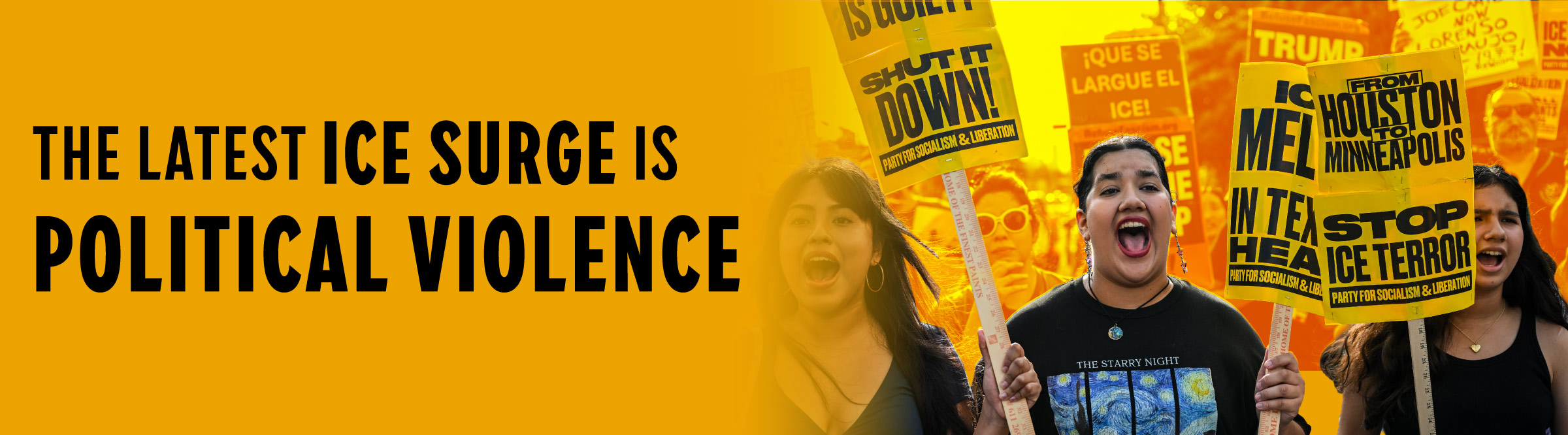

Across the country, people are watching ICE operations surge through workplaces, neighborhoods and courthouses again. Masked agents are appearing in public with greater force. Detention has expanded. Fatal encounters have again become more frequent. The Trump administration calls this immigration enforcement.
That description is both technically accurate and politically and morally inadequate. Immigration enforcement has evolved under the Trump administration into something else entirely: federalized political violence and repression.
Political violence is not simply the presence of force. A democratic state uses force at times. The question is what the force is doing, to whom, under what rules and with what effect on public life. Not every immigration arrest is political violence. But enforcement becomes political violence when state force is deployed at scale in ways that discipline whole communities beyond the person immediately seized. It becomes repression when that force narrows who may speak, move, assemble, work, seek help, document abuse or challenge public authority without fear.
That is what makes the current ICE surge different from ordinary enforcement. The pattern is not only arrest and removal. It is masked agents, workplace operations, courthouse intimidation, unmarked stops, wrong-person encounters, hidden evidence, missing body-camera footage, fatal outcomes and resistance to scrutiny. Taken together, these practices do more than enforce immigration law. They teach people to shrink their lives.
This is not an inference drawn only from the fear communities report. The administration has described the strategy in its own language. DHS said ramped-up enforcement was “sending a clear message to anyone else in this country illegally: Self-deport or we will arrest and deport you.” The White House press release claimed it had “induced two million self-deportations” by restoring “credible consequences.” In a CNN interview, Tom Homan said public-safety targets “should be chilled” and “should be afraid,” and when asked about undocumented parents, added, “They’re not off the table either.”
This is why the racial justice movement, elected officials, culture makers and media must name the people held inside this system differently. Resolution 1900 is not U.S. law. Adopted by the Parliamentary Assembly of the Council of Europe, the parliamentary body of Europe’s leading human-rights institution, it offers a clear standard for recognizing when detention should be understood as political imprisonment. That standard includes detention that violates fundamental freedoms such as expression, assembly or association; detention imposed “for purely political reasons without connection to any offence”; detention that is discriminatory or clearly disproportionate for political motives; or detention resulting from clearly unfair proceedings connected to political motives.
By that standard, people detained through this surge are not merely immigration cases. Their detention serves a larger political purpose: to frighten a population, make dissent dangerous or warn others against standing beside their neighbors. People unfairly arrested, indicted or sentenced for documenting abuse, blocking disappearance, protesting raids or refusing to leave others isolated must also be understood inside this frame. A political prisoner is not only someone jailed for holding formal office, joining a political party or carrying a protest sign. A person becomes a political prisoner when the loss of liberty is used to send a political message: stay quiet, stay home, stay afraid, stay alone.
ICE is now serving both functions.
Many if not most ICE operations fit the description because they seek two audiences. The first is the person stopped, detained or removed. The second is everyone watching online or in real time. Both combined into the same result.
Neighbors change routes to work. A parent stops taking a child to school. A witness to crime puts away a phone. Racially minoritized community members carry their passports. Local officials wonder whether opposing a federal demand will bring federal economic retaliation. The person seized may be the immediate target, but the political and social effect is broader. It changes behavior. Enforcement has become repression.
The administration’s own numbers weaken its public-safety claim. ICE detained 438,537 people between January 20, 2025, and March 11, 2026. Only 13,018, about 3 percent, had a violent felony conviction in the United States. A campaign sold as a pursuit of the “worst of the worst” is far beyond people who fit that description.
Minneapolis showed what large- scale non-violent dissent and civil disobedience looks like when a city resists. An extraordinary federal force entered Minneapolis. Residents who protested or documented it encountered that force directly, and the federal government controls much of the evidence needed to judge its conduct.
Resources
For people and institutions ready to move from concern to preparation, these resources offer places to learn, connect and actJustice for Lorenzo: Day of Action & Accountability Movement Call. Wednesday, July 15, 2026, 8–9PM EDT / 5–6PM PDT.
Colorlines’ DemocracyIs: campaign provides opportunities for learning, analysis, narrative and participation for people working to defend multiracial democracy.
Stacey Abrams’s 10 Steps Campaign helps communities recognize the authoritarian playbook and identify practical ways to resist it.
States at the Core supports local leaders, organizers and public officials facing hate violence, political violence, intimidation, white nationalist activity and other threats to democratic life.
Facing Race, convened by Race Forward in Raleigh this November, will bring together movement leaders, community organizers, government practitioners, artists, educators, funders and others working to build the relationships and strategies that make coordinated action possible.
United Philanthropy Forum’s Advocacy, Awareness, & Action campaign offers tools and coordination for philanthropy infrastructure organizations, foundations and sector leaders responding to political pressure and threats to civil society.
Funders for Justice’s Safety and Security Pledge calls on philanthropy to provide sustained, flexible support for racial justice movements and BIPOC-led organizations facing escalating physical, digital, legal, political and organizational threats.
During that federal immigration surge, officers killed Renée Good and Alex Pretti, both United States citizens. Federal officials quickly cast the victims as aggressors as they had and have done in other incidents around the country. Video and local accounts raised serious questions. Minnesota has sued for access to evidence, alleging federal agencies have obstructed state investigators. That moves the issue beyond anything resembling immigration status. It became about who is allowed to challenge federally implemented political violence and what happens when they do.
The tragic developments in Houston, Texas this week brought federally endorsed political violence into another community. Lorenzo Salgado Araujo was not the person ICE agents were seeking when they stopped his van. DHS says he tried to use the vehicle as a weapon. We’ve heard this story many times before. In violent ICE encounters occurring in Minneapolis, Chicago, and Portland we heard the same explanation from federal officials, including the White House. And once again. Family and witnesses dispute the federal account. The agents were not wearing body cameras, and investigations “continue.” We should leave unsettled facts unsettled while recognizing the civic reality: an unmarked federal operation stopped the wrong man, ended his life and controlled the first public account.
One encounter may be misconduct. Repetition built through deployment, masking, secrecy, official messaging and resistance to scrutiny becomes the method of governing. The state is the main actor here, and non-state actors tell us just how much the main actor’s actions have been normalized. On July 4, hundreds of masked paramilitary members of Patriot Front, a white nationalist organization, marched through Washington, D.C. Their appearance does not establish likely government coordination even with the current White House refusing to condemn their appearance. It does reveal what organized paramilitary organizations believe the present climate permits.
This matters because immigration sits at the center of modern white nationalist politics. The antisemitic Great Replacement theory first developed in white nationalist circles and later adopted in part as White House policy casts immigrants as invaders and demographic weapons, while claiming Jews or “hidden elites” are orchestrating the country’s destruction. That conspiracy binds anti-immigrant hatred to antisemitism, anti-Black racism, Islamophobia and attacks on other minoritized racial, ethnic and religious communities.
People who care about racial justice have to care about what ICE is doing because the machinery normalized against immigrants rarely stays confined to immigrants. When public authority makes masked force and collective suspicion ordinary, paramilitary organizations and lone- wolf attackers come to believe that intimidation has become acceptable political language.
Local culture-makers, public employees, labor leaders, clergy, civil libertarians, business owners and elected officials don’t have to agree on one theory of policing, borders or public safety. They can still form a popular front around a concrete refusal: arbitrary detention, masked federal enforcement, hidden evidence and retaliation against lawful dissent and non-violent civil disobedience can no longer become routine government regardless of which party is in power.
Local government workers can choose to stand where federal power meets daily life. They preserve records, document, protect resident data, maintain language access, administer benefits and decide whether a frightened person meets a public servant or a closed door. Administrative integrity can interrupt repression. Agencies should once again clarify legal authority now, document unusual directives, protect staff from retaliation and build trusted channels with community organizations before the federal crisis arrives, or worse, returns. Local and regionally based philanthropy have a different responsibility. It must fund readiness before the harm normalizes into spectacle. United Philanthropy Forum’s Advocacy, Awareness, & Action campaign helps the field respond to political pressure with coordination.
Funders for Justice’s Safety and Security Pledge calls for sustained, flexible support for racial justice movements and campaigns facing escalating threats. Legal defense, security planning, rapid response, documentation and long-term organizing are critical democratic infrastructure. Local dependable, durable and diverse infrastructure is what turns a frightening incident into a documented pattern, a legal challenge, a public narrative and a coordinated response; without it, each community is left to discover the same danger alone.
For months and possibly years to come. The Trump administration will continue to shape the antisemitic Great Replacement conspiracy into tangible and actualized federal policy. Neighbors and neighborhoods will continue to carry the cost.
The invitation now is not to join one organization or adopt one vocabulary. It is to choose a role before the next surge, the next indictment, the next official lie, the next demand that neighbors stand alone. That’s because our answer to enforced silence must come through neighbors who notice, public workers who hold their offices to their purpose, funders who move before absolute certainty arrives and organizations that reverse engineer fear into joyful and brave coordinated action.
Those roles matter because political repression works by making people freeze into inaction before it tries to make them silent.
A real inclusive democracy emerges when we refuse.